
How Much CBD Should a Beginner Start With? (Dosage Guide)

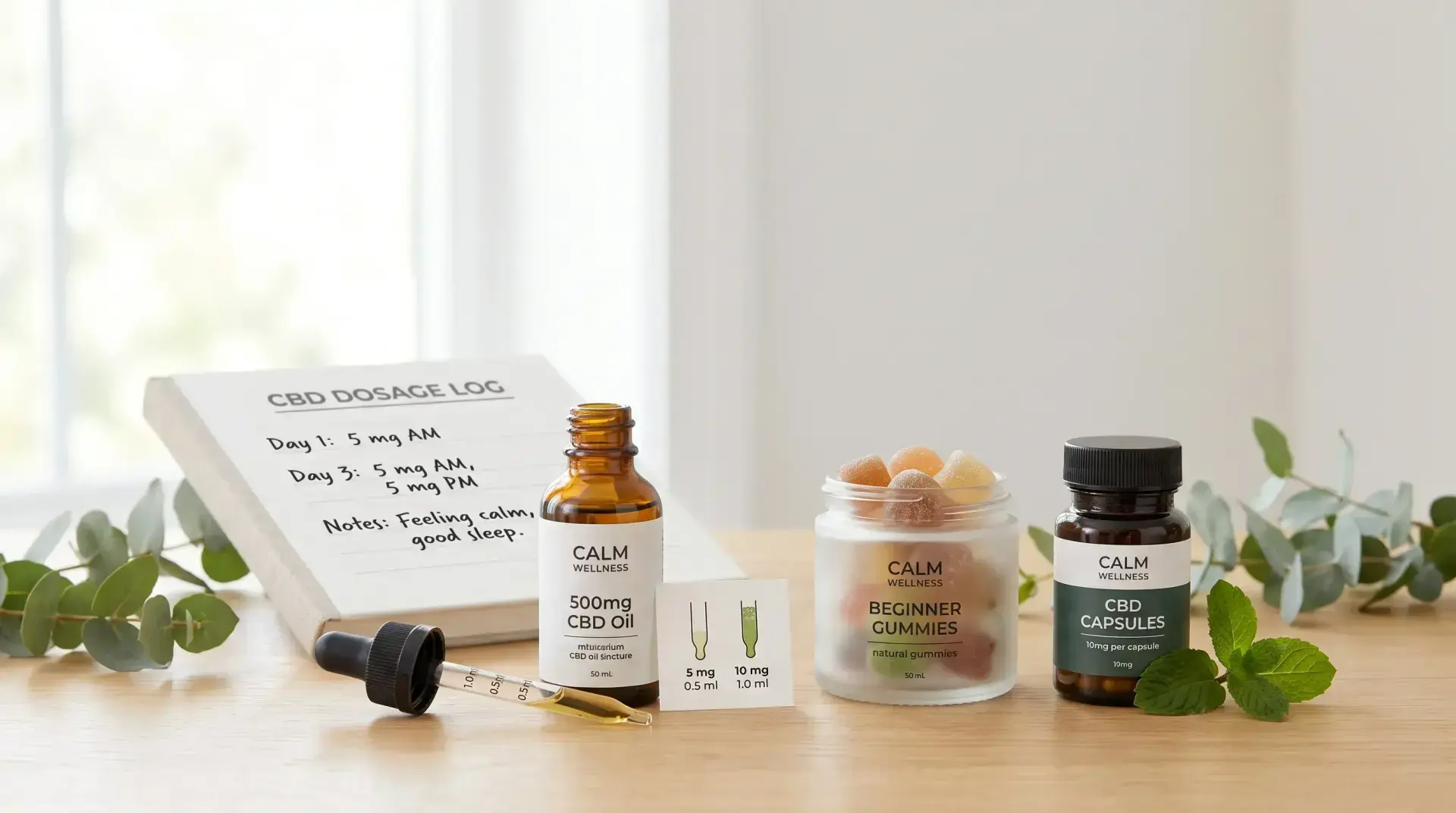
If you are new to CBD, 5–10 mg is a cautious starting range for many adults. However, there is no universal CBD dose that works for everyone. Your sensitivity, product strength, and method of use can all affect your response. The key is to measure your CBD dose carefully and give your body time to respond. If you need to adjust your dose, make small changes rather than taking a much larger amount.
Finding the right CBD dose takes some trial and attention. You need to know how much CBD you are taking and how your body responds. This guide explains CBD dosage for beginners, including how to start, measure, and adjust your dose while comparing different CBD options.
What Is a Good Starting Dose for Someone New to CBD?
The 5–10 mg range is a practical starting point for an over-the-counter CBD product, not a universally established dosage. In a 2021 expert consensus study on medical cannabis dosing for chronic pain, researchers recommended starting a conservative CBD-predominant protocol at 5 mg of CBD once daily, with gradual dose increases based on the patient's response.
There is also no guarantee that the same amount will produce the same response for everyone. Your sensitivity, the product's concentration, how you take CBD, and other factors can affect how your body responds. When choosing a product, clear labeling from trusted brands can make it easier to understand the CBD amount and serving size.
Why Starting with a Low Dose Is Recommended
Starting with a low CBD dose gives you more control. You can see how your body responds before deciding whether you need more. It also makes dose adjustments easier if you notice unwanted effects.
This approach is commonly described as “start low and go slow.” Rather than taking a large amount right away, make smaller changes over time. If you want to increase your dose, change one factor at a time and track your response.
For a simple starting routine, one serving per day can make your CBD dosage routine easier to track. Follow the serving instructions on your product, since recommended use can vary between products. Keep your dose and timing consistent while you assess your response.
How Should a Beginner Increase Their CBD Dose?
If your starting dose feels well tolerated, you can gradually increase your CBD dose. However, avoid making a large jump after only one use. A slower approach gives you more control over your CBD dosing routine. Keep your serving consistent while you assess your response. If you notice unwanted effects, stop increasing your dose and consider speaking with a healthcare professional.
How Long to Stay at Your Starting Dose
Stay at your starting dose for several days before making an adjustment. This gives you time to observe your response to CBD. It also helps you avoid taking more simply because you do not notice an immediate effect.
During this period, keep your CBD dose and timing consistent. You can record the following details:
- Amount of CBD taken
- Time of each serving
- Product type
- Food or drink taken around the dose
- Any noticeable effects or side effects
This simple record can make dose adjustments easier. It also helps you identify patterns in your CBD response over time.
When to Increase Your Dose
Consider increasing your CBD dose only if you tolerate your current amount well. You should also have a clear reason for changing your dose. For example, you may feel that your current amount does not meet your needs.
Do not increase your dose just because you want stronger effects. Instead, give your current serving enough time to evaluate. If you experience unwanted effects, stop increasing the dose and consider speaking with a healthcare professional.
How Much to Increase at a Time
Make small dose adjustments rather than doubling your CBD dose. For example, a person taking 5 mg might consider a small increase to 10 mg after assessing their response. The appropriate adjustment depends on the product and its CBD serving size.
Always check the label before making an increase. A small change in liquid volume can represent a large change in CBD mg. Likewise, one additional gummy may add much more CBD than expected.
A simple approach is:
- Start with a low dose.
- Keep the dose consistent for several days.
- Check how your body responds.
- Increase gradually only when needed.
- Stop increasing if unwanted effects appear.
- The goal is not to take the highest possible amount. Instead, focus on finding a CBD dose that you tolerate well and can measure consistently.
What Factors Affect Your CBD Dosage?
Several factors can affect how your body responds to CBD. Your weight, sensitivity, product strength, and delivery method can all play a role. Because of this, another person's CBD dose may not be the right dose for you.
Key Factors That Can Affect Your CBD Dose
Before adjusting your CBD dosage, consider these factors. They can help you understand why the same amount may feel different from one person to another.
Factor | How It Can Affect CBD Dosing |
Body weight | Weight may influence how your body processes CBD, but it does not determine a fixed dose. |
CBD sensitivity | Some people may notice effects at lower amounts than others. |
CBD potency | Stronger products contain more CBD per mL, gummy, capsule, or serving. |
Reason for use | Your intended use can influence which product and dosing approach you choose. |
Product type | Oils, gummies, capsules, and topicals have different dosing methods and absorption patterns. |
Product strength is especially important when choosing a starting CBD dose. For example, one gummy may contain 5 mg of CBD, while another contains 50 mg. Likewise, tinctures can contain different amounts of CBD per mL.
For beginners, choose a product with clear CBD product labeling. Check the CBD amount per serving, total CBD, and recommended serving size. Then, track your CBD dose per day so you can make gradual adjustments when needed.
How Do You Measure Your CBD Dose?
Knowing how much CBD you are taking starts with reading the product label. The amount can vary between oils, gummies, capsules, and other products. According to a 2024 study of 202 commercially available CBD products, 74% differed from their labeled CBD potency by at least 10%. Therefore, always check the CBD amount and serving size before taking a dose.
The measurement also depends on the product format. Some products provide a fixed amount per piece, while others let you measure a specific amount. Here is what to check with the most common CBD products.
Measuring CBD Oil and Tinctures
CBD oils and tinctures usually list their concentration as CBD per mL. To calculate the amount in each mL, divide the total CBD by the total liquid volume. For example, 600 mg of CBD in a 30 mL bottle equals 20 mg of CBD per mL.
A marked dropper can help you measure your CBD oil dosage. If one full dropper holds 1 mL, that serving would contain 20 mg of CBD in this example. However, dropper sizes and markings can vary, so always check the product instructions.
Quick calculation:
Total CBD ÷ Total liquid volume = CBD per mL
This calculation helps you determine how much CBD you receive from a specific amount of oil.
Related reads: See how cannabis tinctures are made in our guide to how to make cannabis tincture, or learn about an alcohol-free option with how to make cannabis tincture non-alcoholic.
Measuring CBD Gummies and Edibles
CBD gummies usually provide a fixed amount of CBD per piece. For example, a gummy labeled 10 mg CBD provides 10 mg if one gummy is the stated serving. This makes CBD gummy dosage fairly simple to track.
Before taking an edible, check whether the label lists CBD per piece or per serving. One serving may contain more than one gummy. Therefore, do not assume the total CBD in the package represents one dose.
Example:
- 1 gummy × 10 mg = 10 mg CBD
- 2 gummies × 10 mg = 20 mg CBD
Related reads: Learn more about how to make edible cannabis and how to store cannabis edibles properly, including key steps for preparing and storing edible products.
Measuring CBD Capsules
CBD capsules typically contain a fixed amount of CBD per capsule. This makes them easy to measure because you do not need a dropper or measuring tool. Check the label to find the exact CBD mg per capsule.
For example, if one capsule contains 10 mg CBD, taking one capsule provides 10 mg. Taking two provides 20 mg, assuming the product label allows that serving.
Also check the serving size before taking another capsule. Some products may list two or more capsules as one serving. Knowing the CBD amount per capsule helps you keep your daily dose consistent.
Understanding CBD Per Serving on the Label
The CBD serving size tells you how much product the manufacturer considers one serving. The CBD amount per serving tells you how many milligrams that serving contains. These details are more useful for dosing than the total CBD listed on the package.
Before using a new CBD product, check:
Total CBD: The amount of CBD in the entire product.
CBD per serving: The amount of CBD in one stated serving.
Serving size: The amount of product included in that serving.
CBD concentration: The amount of CBD relative to the product volume or weight.
Do not confuse total CBD with CBD per serving. A bottle may contain hundreds of milligrams of CBD, but you may only take a small portion at once. Clear CBD product labeling makes it easier to measure your dose and maintain a consistent routine.
If you are having trouble understanding CBD labels or comparing serving sizes, you can connect with a knowledgeable budtender from Dispo to compare CBD content and dosing information across different products.
How Long Does CBD Take to Work?
CBD does not have the same onset time for every product or person. The delivery method, how you take CBD, and individual differences can all affect how quickly you notice its effects. Because of this, avoid taking another serving simply because you do not feel anything right away.
CBD Product | What to Know About Onset |
CBD oil and tinctures | Oral oils and tinctures may take effect sooner than some edibles. Timing can still vary by product and individual response. |
CBD gummies and edibles | Edibles pass through the digestive system before CBD is absorbed. They may take longer to produce noticeable effects. |
CBD capsules | Capsules also pass through the digestive system, so their onset can resemble other swallowed CBD products. |
CBD topicals | Topicals are applied to the skin rather than taken orally. Their use and expected effects differ from ingestible CBD products. |
There is no single waiting period that applies to every CBD product. Follow the serving directions on your product and give the initial serving enough time to assess your response. Taking additional CBD too soon can make it harder to judge how much you actually need.
What Happens If Your CBD Dose Is Too High?
CBD is generally tolerated by many people, but side effects can still happen. Some people may experience changes in alertness, digestive problems, or mood changes. These effects may improve when CBD use stops or when the amount is reduced.
A phase I clinical trial involving 12 healthy volunteers found that CBD was generally well tolerated, although some participants reported mild or moderate adverse events, including somnolence, sedation, and altered mood.
If you are new to CBD, pay attention to how you feel after taking it. Do not increase your dose if you notice an unwanted reaction. Instead, consider reducing your amount or stopping use and speaking with a healthcare professional if the symptoms concern you.
- Drowsiness or sleepiness: CBD may affect alertness and make some people feel sleepy. If this happens, avoid driving or operating machinery until you know how CBD affects you.
- Diarrhea or stomach discomfort: CBD may cause gastrointestinal problems, including diarrhea, abdominal pain, or an upset stomach. Reducing the amount may help, but persistent symptoms should be discussed with a healthcare professional.
- Decreased appetite: Some people may notice less interest in food after using CBD. If the change continues or becomes concerning, stop increasing your dose and consider speaking with a healthcare professional.
- Mood changes: Mood changes, including irritability or agitation, may occur after taking CBD. If you notice a significant change in your mood, stop increasing your dose and seek appropriate medical advice.
If you notice unwanted effects, do not increase your CBD dose. Consider reducing the amount or stopping use until you understand how your body responds. If symptoms are severe, persistent, or unusual, seek medical advice.
Final Takeaway: Start Low, Go Slow, and Adjust Gradually
If you are new to CBD, 5–10 mg is a cautious starting range for an over-the-counter CBD product. Your starting point may need adjustment based on how your body responds. Follow the product label and give yourself time to assess how you feel before making changes.
Keep your routine simple while you are figuring out your CBD dose. Track the amount you take and any noticeable effects, then make only small changes when needed. If you experience unwanted effects, do not increase your dose, and speak with a healthcare professional when appropriate.
The goal is not to find the highest dose you can take. Instead, it is to find the lowest amount that works well for you while avoiding unwanted effects. Take your time, read the product label carefully, and find a Dispo dispensary near you in Michigan to explore local options.
Frequently Asked Questions (FAQs)
Is 5 mg of CBD enough for a beginner?
Yes, 5 mg can be a reasonable starting amount for someone new to CBD. However, whether it feels effective depends on the person and the product. If you tolerate 5 mg well, you can assess your response before deciding whether an adjustment is appropriate.
Is 10 mg of CBD enough for a beginner?
For some beginners, 10 mg may be enough to notice an effect. Others may respond differently to the same amount. If you are starting at 10 mg, avoid increasing the dose quickly if you do not notice immediate effects.
How long should you wait before increasing your CBD dose?
Give your body enough time to respond to the product before making another adjustment. The right waiting period depends on the type of CBD you use because different delivery methods have different onset times. For edible products, in particular, avoid taking more too soon because effects can take longer to appear.
How do you increase your CBD dosage safely?
Make small adjustments rather than taking a much larger amount. Change one factor at a time and assess your response before increasing the dose again.
How do you know what CBD dose is right for you?
The right dose varies by person. Consider your product strength, individual sensitivity, and response when deciding whether an adjustment makes sense.
Does CBD dosage depend on body weight?
Body weight may influence how a person responds to CBD, but it does not provide a reliable dosing formula for everyone. A simple milligram-per-pound calculation should not replace a cautious starting approach. Individual response and product characteristics also matter.
Should you take CBD with food?
You can take CBD with or without food, depending on the product directions. However, eating can affect how your body absorbs oral CBD. Follow the product label and keep your routine consistent when assessing your response.
Can a beginner take CBD every day?
Some people use CBD regularly, but the appropriate frequency depends on the product and individual circumstances. Follow the product's serving directions and pay attention to how you respond. If you take medications or have health concerns, discuss regular CBD use with a healthcare professional.
Can you take too much CBD?
Taking more CBD does not necessarily produce better results. Higher amounts may increase the chance of unwanted effects, such as drowsiness or digestive problems. If you think your dose is too high, do not take more until you have assessed your response.
References:
- 1. Blessing, E. M., Steenkamp, M. M., Manzanares, J., & Marmar, C. R. (2015). Cannabidiol as a potential treatment for anxiety disorders. Neurotherapeutics, 12(4), 825–836. https://doi.org/10.1007/s13311-015-0387-1
- 2. Bonn-Miller, M. O., et al. (2024). Product labeling accuracy and contamination analysis of commercially available cannabidiol product samples. Frontiers in Pharmacology, 15, 1335441. https://doi.org/10.3389/fphar.2024.1335441
- 3. Brown, J. D., & Winterstein, A. G. (2019). Potential adverse drug events and drug–drug interactions with medical and consumer cannabidiol (CBD) use. Journal of Clinical Medicine, 8(7), 989. https://doi.org/10.3390/jcm8070989
- 4. Grinspoon, P. (2021). Cannabidiol (CBD): What we know and what we don’t. Harvard Health Publishing. https://www.health.harvard.edu/blog/cannabidiol-cbd-what-we-know-and-what-we-dont-2018082414476
- 5. National Institute of Mental Health. (2022). Anxiety disorders. https://www.nimh.nih.gov/health/topics/anxiety-disorders
- 6. Saals, B. A. D. F., De Bie, T. H., Osmanoglou, E., van de Laar, T., Tuin, A. W., van Orten-Luiten, A. C. B., & Witkamp, R. F. (2025). A high-fat meal significantly impacts the bioavailability and biphasic absorption of cannabidiol (CBD) from a CBD-rich extract in men and women. Scientific Reports, 15(1), 3678. https://doi.org/10.1038/s41598-025-87621-4
- 7. Skelley, J. W., Deas, C. M., Curren, Z., & Ennis, J. (2020). Use of cannabidiol in anxiety and anxiety-related disorders.Journal of the American Pharmacists Association, 60(1), 253–261. https://doi.org/10.1016/j.japh.2019.10.014
- 8. U.S. Food and Drug Administration. (2024). What you need to know (and what we're working to find out) about products containing cannabis or cannabis-derived compounds, including CBD. https://www.fda.gov/consumers/consumer-updates/what-you-need-know-and-what-were-working-find-out-about-products-containing-cannabis-or-cannabis
- 9. U.S. Food and Drug Administration. (2025). CDER investigators address the safety of CBD in a randomized trial. https://www.fda.gov/drugs/regulatory-science-action/cder-investigators-address-safety-cbd-randomized-trial